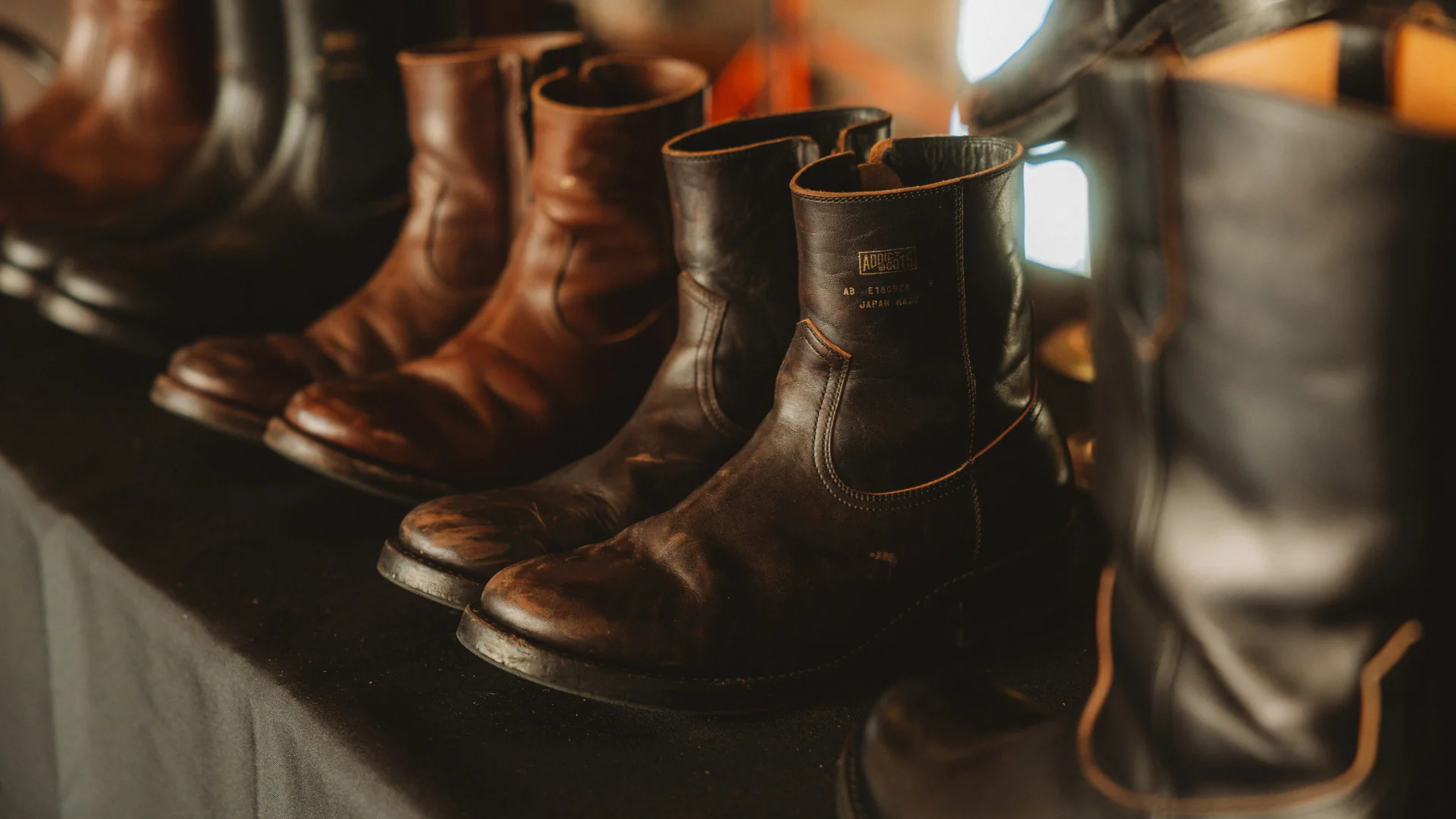
With all due respect to the bootmaking greats, one of the best reasons to go was the independent sellers, because nearly every booth was doing fittings. It’s hard to emphasize just how much better a shoe-buying experience can be when you have a pro there taking your Brannock measurement. Or even a full foot outline, in the case of the full-custom guys.
Speaking of things like “Brannock,” shoemaking has plenty of jargon. Here’s a quick cheat sheet:
- Last: The foot-shaped form a shoe is built around. It decides the fit and shape, which is why your size in one boot can be wrong in another, even from the same brand.
- Brannock: That metal sizing device from every shoe store you’ve ever been in. It measures length, width, and arch.
- Goodyear welt: A strip of leather stitched around the edge of the boot, with the sole stitched to that. It’s sturdy, it’s structured, and it lets a cobbler swap the sole out (again and again).
- Stitchdown: The upper is flared outward and stitched straight down to the sole. It’s simpler, flexible, and a classic for work boots. Also resoleable, and yes, it’s where the expo got its name.
I tried on more boots than I can even remember (occupational hazard) and some of my favorites included a pair from Caswell, a Virginia-based brand that sells classic dressy and workwear boots. I tried the Lisbon Stitchdown, with a price tag in the mid-$400s; Caswell says it runs a little big, with a D width roomy enough for plenty of E-width feet. On my foot? Just right.
The display that really surprised me belonged to Johnny Works, where the eponymous bootmaker who goes simply by Johnny sold boots made by hand in Guangzhou, China. Johnny says that he already had American customers ordering from overseas (which is how Stitchdown found him) and his boots lean toward American heritage with some European touches.
Through a translator, he told me that most of his obsession goes into the last, which he’s reworked through version after version to make it more comfortable. Interesting note: Asian lasts tend to be shorter and wider than Western ones, Johnny said. Ten or twenty years ago, “Made in China” meant cheap, but now, he said he’d put China’s best bootmakers alongside, or above, even some of the ultra-luxe Japanese brands.
“It’s not like Chinese is always a lower tier and Japanese is always high up,” he said. Having tried a pair on, I’m inclined to agree.
Upstairs, Crown Northampton, family-run in England since 1908, hawked individually made-to-order pairs with a nine-to-12-week wait. Its leather sneakers start at $455, shell cordovan runs past $1,100, and US prices include duties and tariffs, so at least that’s a little less math you have to do.
Then there was Russell Moccasin, a bench-made bootmaker from Berlin, Wisconsin, that’s been at it for more than 125 years. Its Heritage Club lets you build a made-to-order boot down to the leather and sole (often S.B. Foot’s Timberjack, from the same tannery a few booths down). The catch? It’s open only to returning customers. The reward for buying a great pair of boots is being allowed to order the next one.



Add comment